Every parent we know has a screen time number in their head.
For some it's "one hour on school days." For others it's "no screens before homework's done." For most it's a half-thought-out rule that worked great until the kid pushed back and then it eroded into "...however much is on the iPad before I notice."
The problem with most screen-time rules isn't the rule. It's that the rule is doing too much work on its own. Screen time, in practice, is a system: a rule, plus the conditions around it, plus the consequences when it's broken, plus the kid having something else to do.
Here's the framework that survives the tired-Tuesday-at-6-p.m. test.
What the research actually says
Quick version, because this comes up:
- The American Academy of Pediatrics dropped its strict daily hour limits a few years ago in favor of a "quality and context" approach.
- The strongest correlations in the research aren't between amount of screen time and outcomes — they're between what the screen replaces and outcomes. A kid doing 2 hours of FaceTime with a friend is different from a kid doing 2 hours of slot-machine-style scrolling.
- Sleep is the line that matters most. Screens push bedtimes later, blue light suppresses melatonin, and the kid who's tired the next day is the kid who has every other problem.
The two practical conclusions: screens shouldn't displace sleep or social/physical activity, and passive scrolling content is meaningfully worse than active, social, or creative screen use.
Most household rules don't distinguish between the two. They probably should.
The daily numbers we'd actually recommend
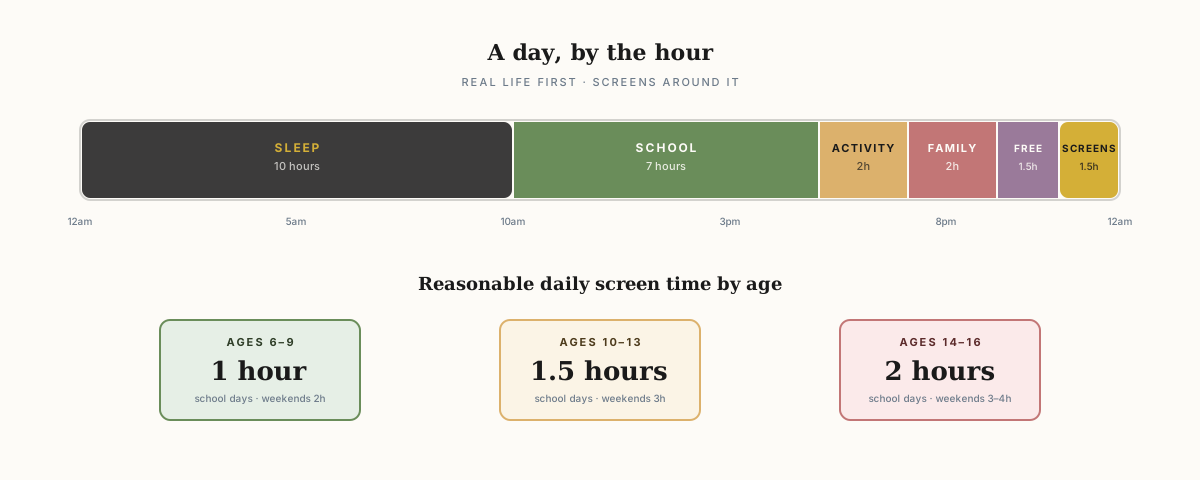
These are reasonable defaults for school days, with weekends running roughly double:
| Age | School day | Weekend | What changes |
|---|---|---|---|
| 6–9 | 1 hour | 2 hours | Mostly co-watched / supervised content |
| 10–13 | 1.5 hours | 3 hours | More autonomy, social use begins |
| 14–16 | 2 hours | 3–4 hours | Phone is also a tool — homework, communication |
| 17+ | Manage their own | Manage their own | Coach, don't enforce |
A few things these numbers aren't trying to capture:
- School work doesn't count. If your 12-year-old is doing math homework on a Chromebook for an hour, that's not your screen time budget.
- Video calls with family / close friends don't count the same. A 7-year-old FaceTiming Grandma is different from a 7-year-old watching unboxing videos.
- Reading on a Kindle / e-reader doesn't count. Different category, different effect.
So when we say "1.5 hours," we mean recreational, passive, or game-style screen time. The Kindle, the homework, the family video calls are separate from that bucket.
The five rules that hold up
The number is less important than the rules around it. These five are the ones we've seen work across the most families:
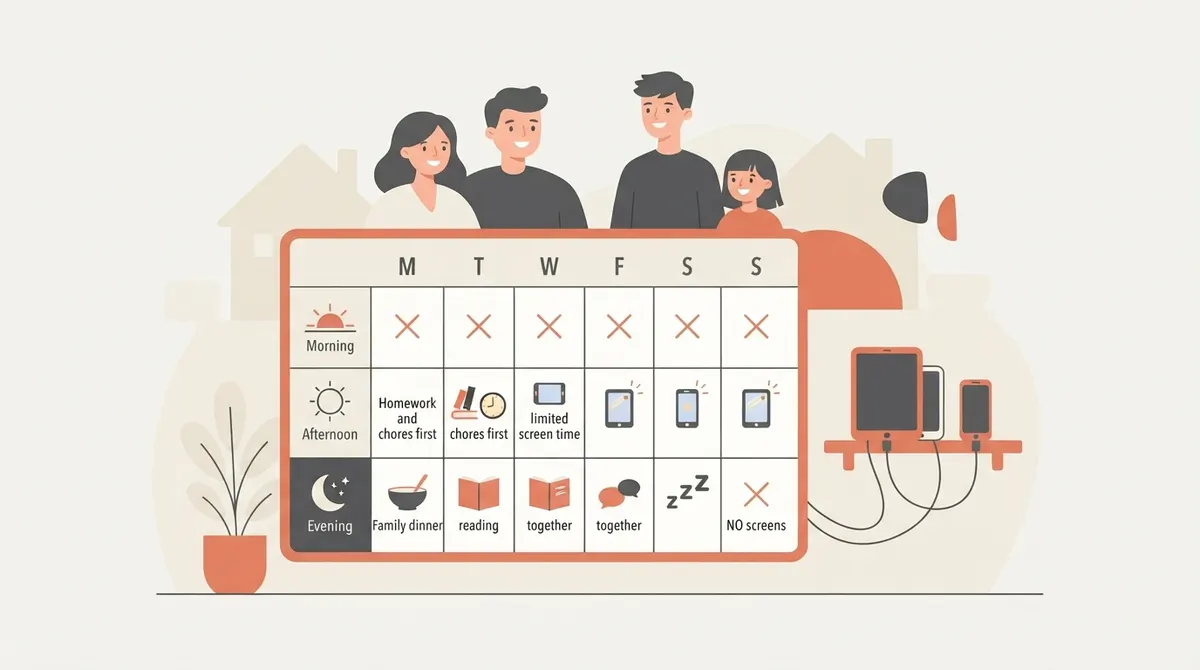
1. No screens before X (the morning floor)
Mornings should not start with a screen. The kid wakes up, gets ready, has breakfast, gets out the door. Screens come later — after school, after homework, after specific things.
The floor changes by age:
- Kids 6–9: no screens until after dinner on school days
- Kids 10–13: no screens until homework is done
- Kids 14+: no screens before they're out the door in the morning
The morning rule is the single most-broken rule in most households. It's also the one that does the most to fix the rest. A kid who started the day with 20 minutes of YouTube has already shifted into passive-consumption mode for the rest of the day.
2. No screens during meals
Meals are family time. Screens stay off the table — phones face-down or in the basket on the counter. This applies to adults too. A rule that doesn't apply to you is a rule the kid can't believe in.
This is also the rule with the biggest research support: kids who eat with family without screens have measurably better outcomes across about a dozen indicators. The dinner table is one of the last places where the family actually talks to each other; don't give it up to a phone.
3. No screens in bedrooms (under 13, at least)
The bedroom screen is where screen time becomes unmanageable. The kid says they went to bed at 9:30 and was actually on the iPad until 11:45. Sleep gets eroded. You don't know what they're watching. You don't know who they're talking to.
For under 13: no screens in the bedroom, period. Devices charge in the kitchen / family room overnight.
For 13–16: depends on the kid, but defaulting to "phones charge outside the bedroom overnight" is a strong policy. Set the phone to dock at 9 p.m. on school nights and it just becomes the rhythm.
For 17+: probably can't enforce this anyway, but you can keep the "phones charge at the kitchen counter" norm in the household as a cultural thing without enforcement.
4. Cap the daily budget, but make it earnable
Pick a number from the table above. That's the base. Beyond that, kids can earn extra screen time the way they earn anything else: by doing things you'd like them to do anyway.
What this looks like in practice:
- 30 extra minutes for reading a chapter book (not a magazine, not a comic)
- 30 extra minutes for doing a chore beyond their baseline list
- An extra hour on the weekend for going for a hike / playing outside for 90 minutes / etc.
This works because it acknowledges that screen time is something the kid wants, and it uses that want to drive behavior you actually care about. The pure "you get one hour, no exceptions" model misses the leverage.
5. No screens an hour before bed
This is the sleep protection rule. The hour before bedtime gets reserved for non-screen activity: reading, board games, conversation, getting ready for tomorrow. Screens compress sleep on both ends — they push bedtime later and they reduce sleep quality after lights-out.
For households where this feels impossible: start with 30 minutes. Get that consistent. Then push to 45. Then 60. Don't try to flip it overnight.
Categories that matter (a quick taxonomy)
Not all screen time is equal. The least-bad categories first, the worst-but-not-evil last:
Genuinely fine (mostly counts as "not screen time"):
- E-readers / Kindle reading
- Video calls with close family / friends
- Educational use that's active (typing a paper, coding, making music)
Moderate (counts, but lower-impact):
- Co-watched content (parents in the room, occasionally talking about it)
- Open-ended creative apps (Scratch, drawing apps, music creation)
- Multiplayer games with friends they know in real life
Standard (this is the bucket the daily limit is for):
- Movies, shows, single-player games on a TV / iPad
- YouTube on a TV with you in the room
- Multiplayer games with online strangers (older kids)
Limit hard:
- Algorithmic scrolling — TikTok, Instagram Reels, YouTube Shorts, etc.
- Solo phone time without context (kid alone in their room with the phone)
- Anything where the kid emerges visibly worse than they went in
The last category isn't really "screen time" the way the first three are. Algorithmic feeds are a different kind of activity — designed by people whose job it is to keep your kid scrolling. The honest version of the rule is: treat algorithmic feeds with the same caution you'd treat a slot machine. Some access is fine for older teens; an open-ended unlimited budget for it is asking for trouble.
What to do when the limit hits zero
Two scenarios. They're different.
Scenario A: the limit hits zero in a household where the kid has alternatives. Other things exist in the kid's life. Friends. Books. Outside. An instrument. Sports. The limit hitting zero just means "the screen part of the day is over, now do something else." Some grumbling, then they go play.
Scenario B: the limit hits zero in a household where the kid has nothing else to do. The kid is bored. They have no friends nearby. They've already read the book. The yard is the same yard it was yesterday. The limit hitting zero feels like punishment, and the kid is right that it kind of is.
You can't fix screen-time rules without fixing scenario B first. The kid needs alternatives that are actually appealing. That doesn't mean you have to schedule them — actually the opposite. Unstructured time, real friends, accessible activities, a backyard or a park nearby, a few books that genuinely interest them. The richness of the kid's offline life determines how the screen-time rule lands.
This is the hidden work of screen-time management: it's not just the rules. It's the world the kid lives in outside the rules.
How Haven handles screen time
We built the rewards system in Haven partly with this in mind. Screen time is a reward you can configure — earn points for tasks, redeem points for screen-time minutes. The kid sees the math: 30 minutes of reading = 30 minutes of bonus screen. Two chores done = 30 more minutes.
It's not magic. The kid can absolutely still ignore the system and stare at YouTube. But it shifts the frame — screens are something you earn around, not a default that runs until you're told to stop. For families who have struggled with screen-time enforcement, that frame shift is often the unlock.
Common questions
My kid is way over these limits. How do we get back to reasonable? Don't crash-diet. If your kid is at 4 hours a day on a school night, going to 1 hour tomorrow will end in war. Cut by 30 minutes a week. Replace the cut time with something specific (a family game night, an outside hour, a board-game night with a friend). Six to eight weeks gets you to a sustainable level without the household imploding.
What about ADHD kids — they really need the dopamine hit of screens? There's a kernel of truth here, and it's also a trap. ADHD kids are more dysregulated by long, passive, algorithmic feeds, not less. Short, active, social, or creative screen use is fine and sometimes really helpful. The endless YouTube hole is the worst version for these kids specifically.
My kid's friends all have phones / social media / TikTok and we're the holdouts. You're not the holdouts; you're just visible to your kid. The data on what families are actually doing is messier than it looks from the playground. That said, by 13–14 some kind of texting/communication tool becomes genuinely useful for social life. The rules around that ("phones charge in the kitchen at 9 p.m.") matter more than the existence of the phone itself.
How do I handle screens when we travel? Looser rules are fine. Six-hour flights are not the hill to die on. The kid won't generalize "I had unlimited iPad on the plane" into "I have unlimited iPad at home." Most kids understand context fine if you set it.
Should I monitor what they're watching? For kids under 13, yes — open-monitor, not stealth-monitor. They know you check, you check periodically, the conversation is part of how they learn what's appropriate. For teens, it shifts to coaching: less monitoring, more conversation about what they're seeing. The relationship matters more than the surveillance.