 There are exactly three questions every family is actually asking about allowance, in the same order:
- How much?
- How often?
- Should we tie it to chores, or not?
The internet will hand you a lot of opinions on each, plus a few books, plus a stranger at the playground who's very sure their system is the right one. Here's the practical version — what amounts families actually pay, the four most common structures, and the honest tradeoffs on the chore question.
How much: the rule and the reality
The most-cited rule is $1 per week per year of age. Six-year-old gets $6. Twelve-year-old gets $12. Sixteen-year-old gets $16.
Most families don't actually pay it that cleanly. The real-world numbers smooth out — younger kids get less per year of age (because $1 to a five-year-old is more than enough), and the curve gets steeper in the tween/teen years (because $12 to a twelve-year-old going to the movies isn't much).
Here's what families typically land on, smoothed:
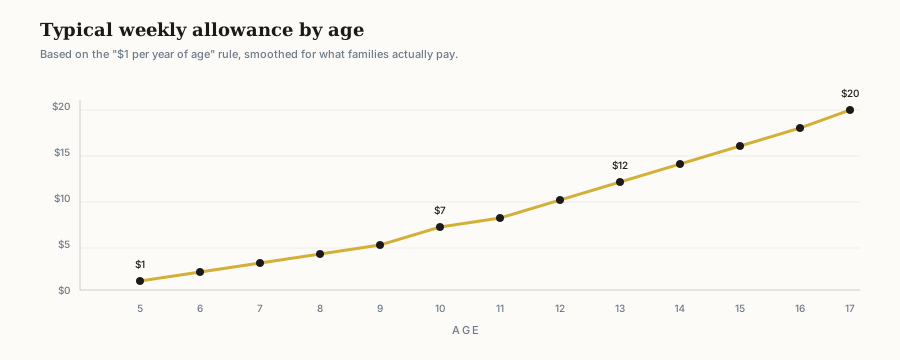 A few things worth noting from those numbers:
- Under age 8, money is mostly symbolic. A five-year-old doesn't need an allowance to buy anything; they need to learn what it feels like to have $1 they're in charge of. Keep amounts small. The lesson is conceptual.
- Age 9–12 is when kids start spending — money has stakes (the snack at the pool, the Roblox card, the thing they want at the bookstore). This is when "how much" starts mattering for real.
- Teen amounts vary wildly depending on whether they have a job, get gas money, pay for their own activities, etc. The numbers above assume a teen who isn't yet earning their own income. Adjust down if they are.
If your household budget is tight, scale the whole curve down — what matters more is the system, not the exact dollars.
How often: weekly wins
Adults get paid every two weeks or monthly. Kids should get paid weekly.
The reason isn't financial — it's pedagogical. Kids have a much shorter time horizon for cause-and-effect. If a 7-year-old "earns" their allowance on Monday and gets paid the following month, the connection is gone. Weekly is short enough that the money still feels like it came from their work, and long enough that there's an actual saving / spending decision to make.
Pick a day. Sunday is the most common pick because the week starts fresh and the kid has time to budget before Monday. Friday is the second most common (end-of-week reward). Just pick one and stick to it. Inconsistency is what kills any allowance system.
The three-jar split
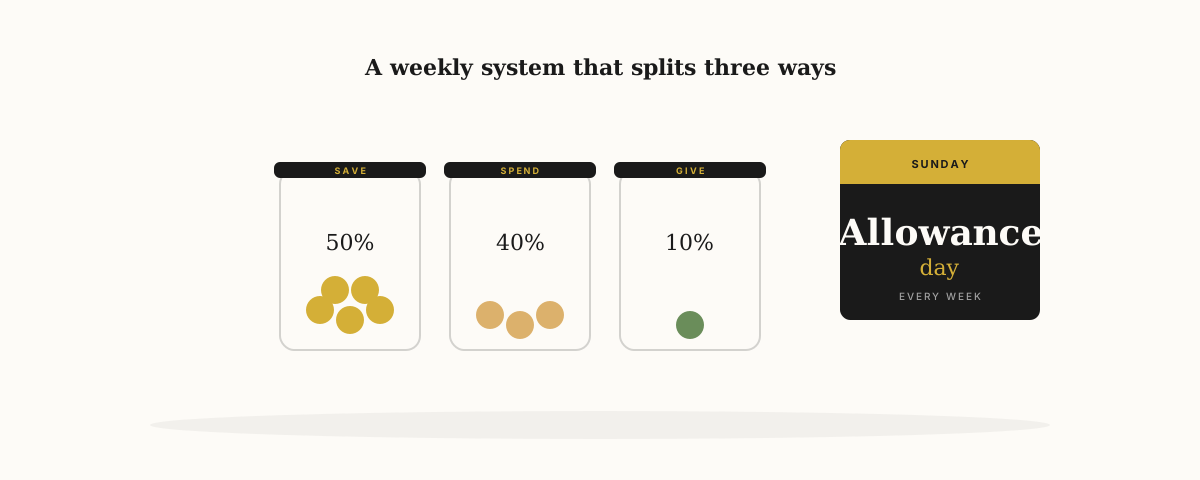
This is the system we recommend most often. Whatever the weekly amount is, the kid splits it three ways:
- 50% Save — long-term, untouchable until a specific goal
- 40% Spend — they can blow this on anything that doesn't break a household rule
- 10% Give — donate, give to a sibling, contribute to a family cause
The ratios aren't sacred. Some families do 33/33/33. Some skip "Give" until kids are older. The point is the split — that money has three different jobs (saving for something big, spending now, giving away) and that the kid sees each job as a separate pile, not one big number.
This is also where the visual reinforcement matters: three actual jars work great for younger kids. For tweens and up, a digital equivalent (most family-money apps have this, including Haven's points system if you map points to real money) is fine.
The four structures families use
1. Unconditional weekly allowance
The kid gets the money. Period. It's not tied to chores. It's their share of the household resources, like food and shelter.
Why families pick it: chores aren't a thing kids get paid for — they're a baseline expectation of being part of the family. Tying every chore to dollars makes refusal cheap ("I'll skip the $2 this week if it means not unloading the dishwasher"). Unconditional allowance teaches money management without entangling it with work.
Why families don't: feels too soft. Especially for parents who grew up earning their money, paying a kid for nothing seems backwards.
Best for: young kids (under 10), and families where chores are genuinely treated as non-negotiable household contributions.
2. Allowance tied entirely to chores
Every chore has a price. Kid does the chores, kid gets the money. Misses chores? Loses the corresponding pay.
Why families pick it: it teaches the real-world lesson — work → money. Direct, fair, no ambiguity.
Why families don't: see above. The kid figures out fast that they can opt out by giving up the money. If they don't care about money that week, the chore doesn't get done. And there are some chores you really need them to do regardless of what they want.
Best for: older tweens / teens who actually want money and are old enough to feel the consequences of not earning it.
3. Base allowance + extras
The blend that most families settle on after trying the other two. The kid gets a small base allowance unconditionally (their "household member" share), AND they can earn extras by doing bonus chores beyond the baseline.
Example: a 10-year-old gets $5/week no matter what. They're expected to make their bed, feed the pets, and unload the dishwasher — those are "household member" chores. But if they want to mow the lawn ($5), clean the garage ($10), or wash the car ($8), they can pick up bonus money.
Why this works: the required chores stay required. The money stays earnable. The kid learns money management on the base, and entrepreneurship on the extras.
Why families don't: more bookkeeping. You have to track which chores are which.
Best for: most families, most ages.
4. Behavior/effort-based
Allowance is tied to broader behavior — being kind to siblings, finishing homework, hitting personal goals. Specific chores aren't the metric; the overall vibe of the week is.
Why families pick it: great for younger kids, where you're really teaching general responsibility, not literal labor.
Why families don't: subjective, easy to drift into "did they earn it this week?" disputes. Hard to scale to teens.
Best for: kids 5–9. Most families graduate to a more concrete system later.
The chore question, honestly
Should you tie allowance to chores? Here's the version we've seen actually work across the most families:
Tie some chores to money. Don't tie all of them.
Specifically:
- Daily/household chores (make your bed, feed the pet, set the table, unload the dishwasher): these are part of being in the family. No money attached. The "consequence" for skipping isn't financial — it's "the chore still has to get done, and now I'm annoyed."
- Bigger / occasional chores (mow the lawn, wash the car, deep-clean the garage, babysit a younger sibling for a real stretch): these can absolutely earn money. They're more adult-feeling and they're not part of the "you live here, you contribute" baseline.
This hybrid keeps the floor (kid contributes regardless of mood) and adds a ceiling (kid can earn more by stepping up). It also matches what adulthood actually looks like — you make your own bed for free and you get paid for actual jobs.
A clean starter setup
If you're starting fresh, this is what we'd put in place:
- Pick the amount using the chart above as a starting point, adjusted for your budget.
- Pick the day — Sunday is the default for a reason.
- Pick the structure — base + extras is the most-survival-rate option (and it's what Haven's points system maps to by default).
- Set up the split — 50/40/10 or your own ratios.
- Decide what's free and what's paid. Write it down. Free chores get done. Paid chores are opt-in.
- Run it for 60 days before adjusting. Allowance systems take a few weeks to settle. Resist the urge to tweak before then.
How Haven handles allowance
We built the points system in Haven specifically to map to real money if you want it to. Each chore can have a point value. Each point can be worth a fixed dollar amount in your household (you set it). Kids see their balance, they see what they've earned, they can "spend" points on rewards you set up (a movie outing, a video game, screen time, money).
If you want the structure but don't want the bookkeeping, that's the gap we're trying to fill. Try it free — it's faster than re-inventing the spreadsheet every Sunday.
Common questions
Should we pay in cash or via an app? Both work. Cash is visceral — kids feel it more, especially under age 10. An app is easier to track, harder to lose, and scales better as the amounts grow. Most families end up with cash for younger kids and a digital system for tweens up.
What if my kid blows all their allowance on candy? That's the lesson. The first month of an allowance system is supposed to involve at least one regret purchase. The point is that they regret it with $4 of stakes now, instead of $4,000 of stakes when they're 22.
What about birthday money? Same system. Run it through the three jars. Big windfalls are the best opportunity to teach saving — a kid who learns to put 50% of a $100 birthday gift into "save" learns more in that one moment than they will from a year of $5 allowances.
At what age should the allowance stop? When they have a real job that covers the equivalent. Many families taper through the teen years — full allowance at 13, half at 16 if they're working, zero by college. Some keep something going through college as a budget supplement. Either is fine; what matters is that the kid sees the end coming and starts replacing it with their own income.