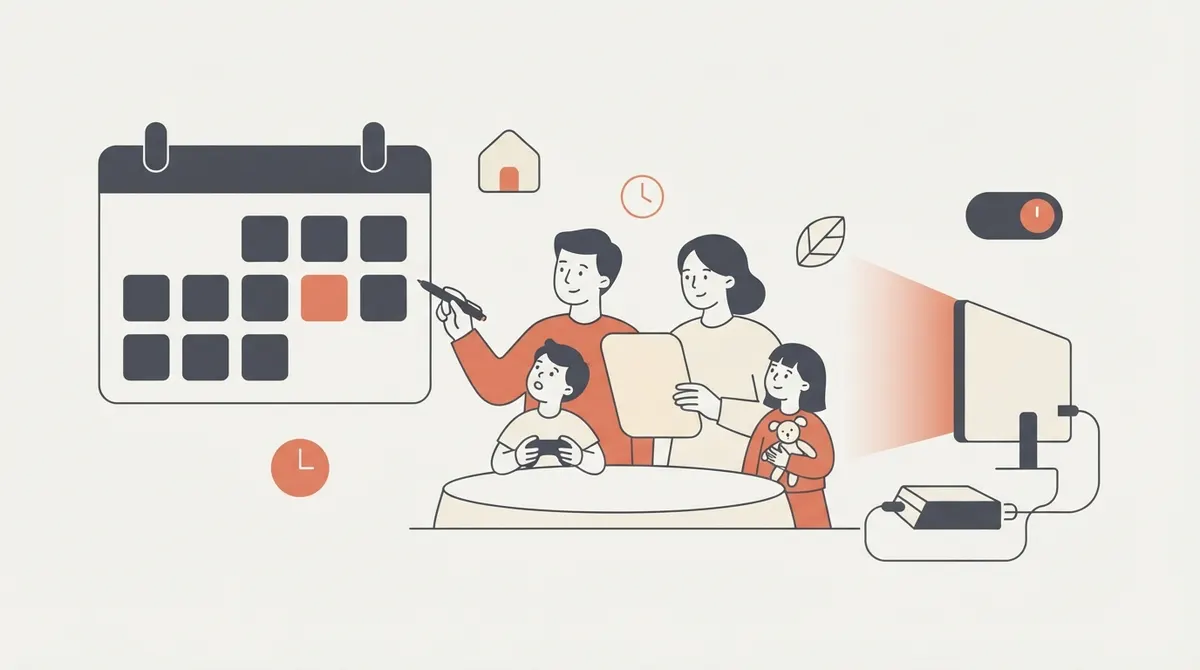
Video games are a big part of many families' lives today, and that's okay. They can be fun, social, and even educational. But if you're like many parents, you've probably faced the challenge of managing gaming chaos: endless requests for more time, arguments over what games are appropriate, and battles when it's time to log off. It's a common source of friction in the home.
What if you could replace those daily battles with clear expectations, a shared understanding, and a whole lot more peace? That's exactly what a family video game agreement can do. It's not about banning games; it's about establishing clear boundaries that everyone understands and agrees to, transforming a potential source of conflict into a framework for responsible play.
Why a Family Video Game Agreement Works
Many families struggle with inconsistent rules or last-minute decisions about gaming. This often leads to frustration for everyone involved. A family agreement addresses this head-on by creating a formal plan. Here's what it offers:
- Clarity and Consistency: Everyone knows what's expected, eliminating confusion and reducing arguments.
- Reduced Friction: When rules are established beforehand, enforcement becomes less about parental power struggles and more about upholding an agreed-upon standard.
- Teaches Self-Regulation: Involving your children in creating the agreement helps them understand the reasoning behind the rules and fosters a sense of responsibility for their own choices.
- Shared Ownership: When kids contribute to the rules, they are more likely to respect and follow them.
- Predictability: Children thrive on routines and knowing what to expect. A contract provides this structure for their gaming time.
Think of it as setting up guardrails for a fun activity, ensuring it stays fun for everyone involved, rather than becoming a source of stress.
Building Your Family Video Game Contract
Creating this agreement should be a family project. The more input everyone has, the more likely it is to be successful. Here are the steps to build your own effective video game contract:
Step 1: Gather Input from Everyone
Before you write anything down, sit down with your children. Explain that you want to create a fair system for video games that works for the whole family. Ask them:
- What are their favorite games? Why do they like them?
- How much time do they think is reasonable for gaming each day or week?
- What rules do they think are important to keep gaming fun and fair?
Listen to their perspectives. Even young children (around age 6-7) can contribute to a basic discussion about fairness and rules. For older children and teens, their input is crucial for buy-in.
Step 2: Define Game Content Rules
This is about deciding what games are appropriate for your children based on their age and maturity. The ESRB (Entertainment Software Rating Board) provides ratings (E for Everyone, T for Teen, M for Mature) that are a good starting point, but you know your child best.
- ESRB Ratings: Discuss these. For example, you might decide that games rated M (Mature 17+) are off-limits for anyone under 17 in your home. T (Teen 13+) might be allowed with parental review.
- Specific Game Types: Are there certain genres you want to restrict? For example, games with excessive violence, gambling themes, or unmoderated online chat features might be concerns.
- Online Interaction: Will you allow online multiplayer games? What are the rules for interacting with strangers online? (e.g., no sharing personal information, reporting inappropriate behavior).
Example Rule: "Only games rated E, E10+, or T are permitted. Any game rated T must be approved by a parent before playing. Games rated M are not allowed."
Step 3: Set Clear Time Limits
This is often the trickiest part, but consistency is key. Time limits should be realistic and consider your children's age, school schedule, and other commitments.
- Daily Limits: How many minutes or hours per day? For example, 60 minutes on weekdays for an 8-year-old.
- Weekly Limits: Some families prefer a total weekly allowance (e.g., 7 hours per week) that kids can manage themselves.
- Weekday vs. Weekend: It's common for weekend limits to be more generous. For instance, 1 hour on school nights and 2 hours on weekend days.
- Consider Age: Younger children generally need shorter, more frequent breaks. Teens might handle longer sessions but still need clear boundaries.
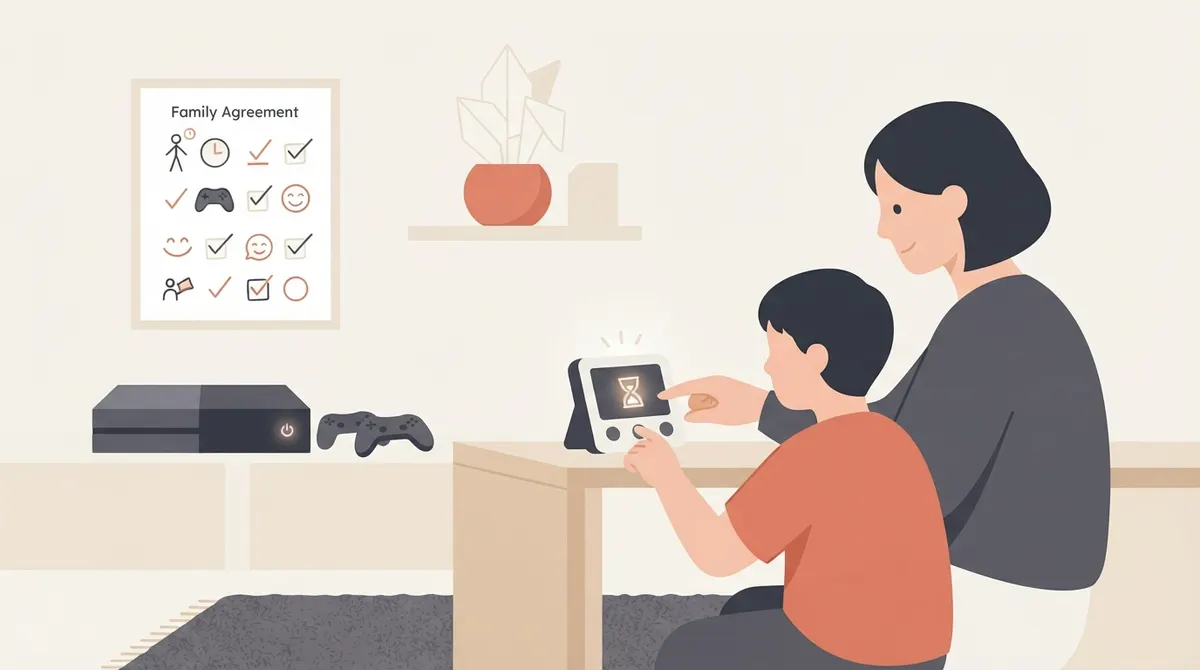
- Tracking Time: How will you track it? A kitchen timer, a parental control app on the console or device, or simply asking your child to be responsible are all options. Parental control apps often offer a precise and automated way to enforce limits.
Example Rule: "Gaming time is limited to 60 minutes on school days (Monday-Friday) and 90 minutes on weekend days (Saturday-Sunday). Time will be tracked using the console's built-in parental controls or a timer set by a parent."
Step 4: Establish When and Where Gaming Happens
Structure helps prevent gaming from taking over other important activities.
- Time of Day: No gaming before school? Only after homework and chores are done? Before dinner but not after 8 PM? Be specific.
- Location: Is gaming allowed in bedrooms, or only in a shared family space like the living room? This can help monitor content and interactions.
- Context: No gaming during family meals, while guests are over, or when specifically asked to do something else.
Example Rule: "Gaming is only permitted after homework and chores are completed, and before 8:00 PM. All gaming must take place in the living room on the family television. No gaming during meals or designated family time."
Step 5: Outline Consequences for Breaking Rules
Consequences are not about punishment; they're about teaching responsibility and the natural outcomes of actions. They must be clear, consistent, and logical.
- Loss of Gaming Time: The most direct consequence. (e.g., "If you exceed your time limit by 10 minutes, you lose 20 minutes from tomorrow's gaming time.")
- Temporary Gaming Ban: For repeated or more serious infractions (e.g., "Breaking a content rule results in a 24-hour gaming ban.")
- Loss of Other Privileges: Less directly related, but sometimes necessary for serious breaches of trust.
- Escalation: Define what happens for a first offense, second offense, etc.
Example Consequences Table:
| Infraction | First Offense | Second Offense (within 7 days) | Third Offense (within 7 days) |
|---|---|---|---|
| Exceeding Time Limit | Lose double the extra time from next session | 24-hour gaming ban | 48-hour gaming ban |
| Playing an Unapproved Game | 48-hour gaming ban | 3-day gaming ban | 1-week gaming ban |
| Gaming During Restricted Time | Lose next day's gaming time | 24-hour gaming ban | 48-hour gaming ban |
Step 6: Define Rewards for Following Rules (Optional but Recommended)
Positive reinforcement can be very powerful. Consider including ways to earn extra gaming time or other privileges.
- Bonus Time: (e.g., "Complete all chores for the week without prompting, earn 30 extra minutes of gaming time on the weekend.")
- Choice of Game: Allow choice from an approved list.
- Other Privileges: Family movie night, choosing dinner, etc.
Step 7: Review and Sign the Agreement
Once drafted, review the agreement as a family. Make sure everyone understands all parts of it. Then, have everyone sign it – adults and children alike. This makes it a formal, shared commitment. Print it out and display it prominently, perhaps on the refrigerator or a family bulletin board, so it serves as a constant reminder.
Plan to review the agreement periodically, perhaps every 3-6 months, or when a child reaches a new age milestone. Needs and interests change, and the contract should evolve with your family.
The Customizable Family Video Game Contract Template
Here's a template you can use to create your own family video game agreement. Fill in the blanks with what works best for your household.
Family Video Game Agreement
Date Created: [Date]
This Agreement is Between: [Parent/Guardian Name(s)] and [Child's Name(s)]
Our Family's Core Values for Gaming: We believe video games can be fun and engaging when balanced with school, chores, family time, and outdoor activities. This agreement helps us ensure gaming remains a positive experience for everyone.
1. Approved Games (Content Rules):
- We will only play games with an ESRB rating of [e.g., E, E10+, or T].
- Any game rated [e.g., T] must be approved by a parent before playing.
- Games with [e.g., excessive violence, unmoderated chat, gambling themes] are not permitted.
- When playing online, we agree to [e.g., never share personal information, be respectful to others, report inappropriate behavior to a parent].
2. Gaming Time Limits:
- Weekdays (Monday-Friday): [e.g., 60 minutes] per day.
- Weekends (Saturday-Sunday): [e.g., 90 minutes] per day.
- Weekly Total (Optional): [e.g., 7 hours] per week.
- We will track time using [e.g., a kitchen timer, console parental controls, parental supervision].
3. When and Where Gaming Happens:
- Gaming is permitted only after [e.g., homework is complete, chores are done, family dinner].
- Gaming must end by [e.g., 8:00 PM] on weekdays and [e.g., 9:00 PM] on weekends.
- All gaming will take place in [e.g., the living room, a shared family space].
- No gaming during [e.g., meals, family events, when guests are over, designated quiet time].
4. Consequences for Breaking Rules:
| Infraction | First Offense | Second Offense (within [e.g., 7] days) | Third Offense (within [e.g., 7] days) |
|---|---|---|---|
| Exceeding Time Limit | [e.g., Lose double the extra time from next session] | [e.g., 24-hour gaming ban] | [e.g., 48-hour gaming ban] |
| Playing Unapproved Game | [e.g., 48-hour gaming ban] | [e.g., 3-day gaming ban] | [e.g., 1-week gaming ban] |
| Gaming During Restricted Time | [e.g., Lose next day's gaming time] | [e.g., 24-hour gaming ban] | [e.g., 48-hour gaming ban] |
| [Add other specific infractions] | [Specific consequence] | [Specific consequence] | [Specific consequence] |
5. Rewards for Following Rules (Optional):
- [e.g., Completing all assigned chores for the week earns an extra 30 minutes of gaming time on the weekend.]
- [e.g., Maintaining good grades results in choosing one new approved game each semester.]
6. Review Date: This agreement will be reviewed on [Date] or as needed.
Signatures:
___________________________ (Parent/Guardian)
___________________________ (Parent/Guardian)
___________________________ (Child's Name)
___________________________ (Child's Name)
Enforcing Time Limits and the Contract
Drafting the contract is only half the battle; consistent enforcement is crucial for its success. Here are practical tips to help you stick to the plan:
- Use Tools: For younger children, a simple kitchen timer is effective. For older kids and specific consoles, utilize built-in parental controls. Most modern gaming systems (PlayStation, Xbox, Nintendo Switch) and operating systems (iOS, Android, Windows) have robust parental control features that allow you to set daily time limits, enforce content restrictions, and even schedule play times. Explore these settings on your family's devices.
- Be a United Front: If there are two parents or guardians, ensure you are both on the same page and enforce the rules consistently. Children quickly learn to exploit inconsistencies.
- Follow Through on Consequences: This is perhaps the most important part. If a rule is broken, the consequence must be applied, calmly and consistently. Don't negotiate, lecture excessively, or back down. "The contract says..." is a powerful phrase.
- Regular Check-ins: Briefly review the contract's effectiveness during family meetings. Ask if anything needs to be adjusted. This shows that the agreement is a living document, not a rigid set of dictates.
- Model Good Behavior: If you have your own screen time rules (e.g., no phones at the dinner table), make sure you follow them too.
Managing video game use doesn't have to be a constant source of stress. With a clear, collaborative family agreement, you can set healthy boundaries, teach valuable self-regulation skills, and bring more peace and predictability to your family's digital life. It's an investment in your family's harmony that pays off every day.
Common questions
What if my child refuses to sign the agreement?
Explain that the agreement is about setting clear family expectations for a privilege, not a right. You can express that gaming is a part of family life only when there's an agreement on how it will be managed. If they refuse to sign, the default might be no gaming until an agreement is reached, or very limited, parent-controlled access.
How often should we review or update the contract?
It's a good idea to review the contract at least once a year, or whenever there's a significant change in your child's life (e.g., starting a new school year, turning a specific age, or new gaming devices entering the home). Your family's needs and gaming landscape can change, and the contract should adapt.
What if my child tries to negotiate or argue every time they have to stop playing?
Refer back to the agreement. "The contract says your time is up." Avoid lengthy debates. If they continue to argue, calmly apply a consequence as outlined in the contract. Consistency here is key to teaching them that the agreement is the final word, not a starting point for negotiation.
My kids have different ages. Should we have separate contracts?
For vastly different age groups (e.g., a 7-year-old and a 15-year-old), separate time limits and content rules within one comprehensive agreement, or even slightly varied individual agreements, can be beneficial. The core principles of respect and responsibility should remain the same for everyone, but the specifics can be tailored to age-appropriate needs.
How can I stop my child from playing games on friends' devices when they visit?
This is a great point for the contract. Discuss and include a rule about respecting other families' rules and your own. For instance, "When at a friend's house, we will respect their family's gaming rules, but our content rules still apply (e.g., no M-rated games)." This requires clear communication with your child and potentially with other parents.