
The chart on the fridge lasts about three weeks.
Then a kid stops checking it. Then another one "forgets." Then one parent ends up doing the trash and the dishes and the lunches because nobody else remembered, and by week six you're back where you started — except now everyone's a little annoyed.
It's almost never the chores. It's the rotation system underneath them. The wrong shape makes a fair workload feel unfair, and once a kid decides a thing is unfair, that's it. You're never winning that argument again.
So below: five systems that hold up in real households. When each one fits, what breaks it, and a template you can copy.
1. Round-robin
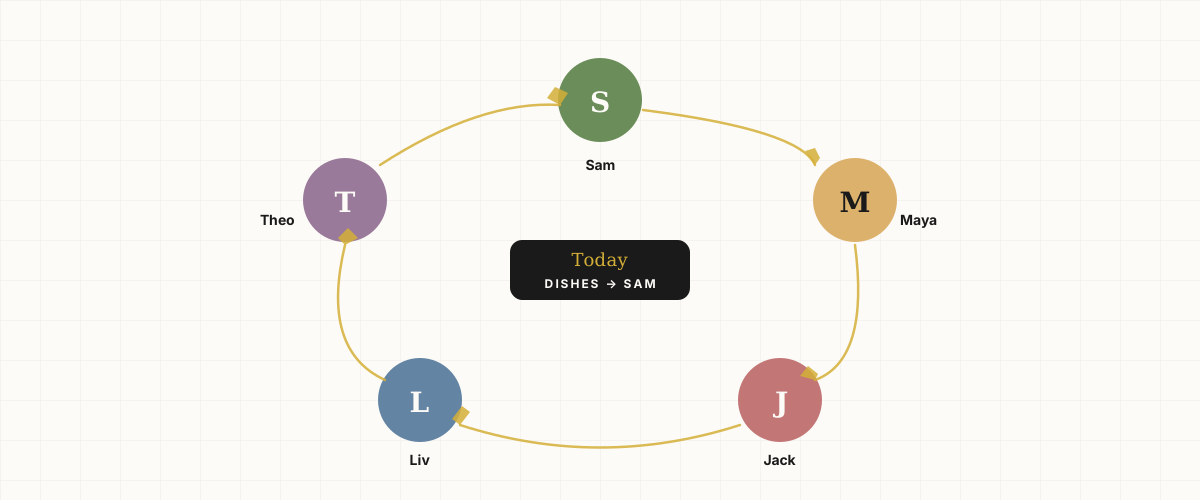
Pick a list of kids and a list of chores. Each day, every chore advances one slot down its list. Monday Sam does the dishes. Tuesday Maya. Wednesday Jack. Eventually it loops back to Sam.
Looks like this:
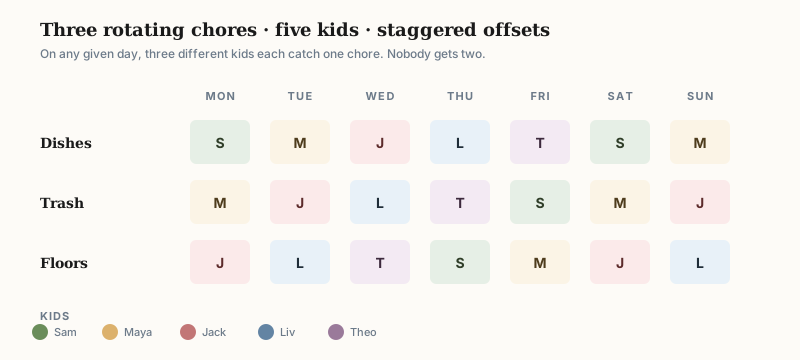
The trick is in the offsets. If all your chores start on the same kid, that kid catches every chore on Mondays — which is the version most families actually accidentally build, and the version everyone hates. Start each chore one position down the list and they fan out cleanly across the week. With three chores and five kids, every day three different kids get one chore, and over five days each kid does each chore once.
Fits best when the kids are similar ages and the chores are similar effort. Round-robin's whole pitch is "this is mathematically fair" — and it is. But if one chore is mowing the lawn and another is wiping the table, the kid stuck with the mower this week will not be impressed by your math.
2. Fixed-day, fixed-kid
Sam owns dishes on Mondays and Thursdays. Maya owns dishes on Tuesdays and Fridays. Forever, or at least until somebody complains hard enough that you switch.
This sounds rigid, and it is. That's the point. Younger kids especially do better when "Tuesday morning" just means "dishes are my job" — there's nothing to check, nothing to negotiate, nothing to forget. The chore is part of the day.
Where it breaks: somebody gets sick. Suddenly the dishes aren't getting done and "covering for Sam" instantly becomes a fairness argument. We've seen one family solve this with a simple rule — if you're out, the next day's person doubles up, and you double up the day they're out next time. Took the heat out of it.
A starting template, with the same three-day pattern repeated:
| Day | Sam | Maya | Jack |
|---|---|---|---|
| Mon | Dishes, lunches | Trash | Pet feeding |
| Tue | Pet feeding | Dishes, lunches | Trash |
| Wed | Trash | Pet feeding | Dishes, lunches |
| Thu | Dishes, lunches | Trash | Pet feeding |
| Fri | Pet feeding | Dishes, lunches | Trash |
Three days they have to remember. Not seven.
3. The weekly shift
Different shape entirely. Instead of rotating chores day-by-day, you rotate areas week-by-week. Sam owns the kitchen this week — all of it. Dishes, wipe-down, lunches, unloading the dishwasher every morning. Next week it's Maya's kitchen, and Sam is on bathrooms.
This works much better than round-robin for older kids (10+) because they get to plan their own week. The kid on kitchen duty figures out their own rhythm — "I'll unload the dishwasher first thing so it's empty all day" — and ownership starts to look like adult-ish ownership instead of children-with-a-checklist ownership.
The catch: a bad week is a really bad week. If Sam has the kitchen during finals week, that's seven days of misery. Worth building in a "swap once a month" rule so kids can trade weeks for legitimate reasons. (Birthday parties, exams, sleepovers. Not "I don't feel like it.")
| Week | Kitchen | Bathrooms | Pets | Laundry |
|---|---|---|---|---|
| 1 | Sam | Maya | Jack | Liv |
| 2 | Maya | Jack | Liv | Sam |
| 3 | Jack | Liv | Sam | Maya |
| 4 | Liv | Sam | Maya | Jack |
4. Point-weighted
This is for families where the chores are wildly different. Mowing isn't dishes isn't sweeping. If you try to round-robin across all of them, somebody's getting handed a 90-minute job on the same day somebody else gets a 5-minute job and calling it equal.
So you stop calling them equal. Each chore gets a point value: dishes = 2, vacuum = 4, mow the lawn = 8. The system assigns chores to whichever kid has the lowest point total that week. Kid who got the lawn this week does very little else.
The first time you do it, build a point bank like this:
| Chore | Points | How often |
|---|---|---|
| Dishes after dinner | 2 | Daily |
| Take out trash | 1 | 2× / week |
| Vacuum main floor | 4 | Weekly |
| Mow lawn | 8 | Weekly, May–Sept |
| Clean a bathroom | 5 | Weekly |
| Pet feeding | 1 | Daily |
| Laundry (own clothes) | 3 | Weekly |
| Empty dishwasher | 1 | Daily |
Pick chores from the list until each kid hits about 15 points. The math does the fairness.
It's also the system most likely to drift if a parent forgets a week. Point-weighted is the system that benefits most from being automated — it's why Haven's rotation respects point load by default. Doing this by hand on a whiteboard is exactly the chore the chore-system was supposed to remove.
5. Ability-based with rotation inside it
The honest one. Some chores are tied to ability. A 5-year-old isn't mowing the lawn. A 14-year-old isn't going to feel respected putting away their LEGO. So you build two or three tiers based on what each kid can actually do, and you rotate the chores within each tier.
The youngest tier might be: wipe the table after meals, feed the cat, put toys away, set napkins for dinner. The middle tier: empty the dishwasher, vacuum their own room, take out trash, fold their own laundry. The oldest tier: cook one dinner a week, mow the lawn, clean a bathroom, supervise a younger sibling for an hour.
You're not pretending the 5-year-old and the 14-year-old are doing equivalent work. You're giving each of them ownership at their level, and rotating the specific job within their tier so it doesn't get stale.
The risk with this one is the oldest kid getting permanent ownership of the hardest stuff. Mitigate it by rotating the big jobs more aggressively across the older kids, and by making sure the big-kid tier has real variety in it — not just "the chores nobody else can do" but a mix of things that are actually different from each other.
Most families layer two systems
Pick the daily small things (dishes, trash, pets) and round-robin them. Pick the weekly big things (bathrooms, lawn, laundry) and run them as a weekly shift, or distribute by point load.
The mistake we see most often is trying to make every chore fit one logic. Cleaning the toilet doesn't belong in the same rotation as setting the table — totally different frequency, difficulty, age requirement. When you force one rotation to cover both, the kid who got the toilet that week is going to remember it for a long time.
The part that actually matters
Whichever system you pick, the visibility of the schedule is what makes it stick. A chart that everyone can see is a real system. A chart taped to the fridge that gets ignored after two weeks is not a system — it's just paper.
If you've tried to keep one going on the fridge and it died twice, that's the signal to put it somewhere harder to ignore. We built Haven's rotating-task feature for exactly this. You pick the system, pick the kids, and the schedule shows up on every kid's phone or tablet at the start of each week. The math runs in the background. Today's assignments are on today's screen. Nobody has to look at the fridge.
The best chore system isn't the one with the cleanest spreadsheet. It's the one your family actually follows on a Tuesday.
Common questions
How often should chores rotate? It depends on the weight of the chore. Small daily jobs — dishes, trash, feeding the pets — do best on a daily round-robin. Bigger weekly jobs like bathrooms, laundry, or the lawn work better as a weekly shift, where one kid owns an area for the whole week. Most families end up running both at once rather than forcing everything into one rotation.
How do you keep it fair when some chores take much longer than others? Stop pretending they're equal and give each one a point value — dishes 2, vacuuming 4, mowing 8 — then assign each week's chores to whoever has the lowest running total. The kid who got the lawn does very little else that week, and nobody has to argue about whether that's fair.
What happens when a kid is sick or away on their day? Decide the rule before it happens, or it turns into a fairness argument every time. The cleanest version we've seen: whoever is next up covers the missed day, and the kid who was out doubles up the next time the coverer is away. It's reciprocal, so it takes the heat out of it.
Should a 5-year-old and a 14-year-old have the same chores? No, and trying is what makes rotations collapse. Build two or three tiers based on what each kid can actually do, then rotate jobs within each tier so nothing goes stale. The one thing to watch is the oldest kid quietly inheriting every hard job — rotate the big jobs harder, and make sure their tier has real variety in it.