There are roughly two kinds of mornings in a household with kids.
In the first kind, everyone gets up, gets dressed, eats breakfast, and walks out the door. Maybe one minor crisis (the lunchbox, a missing sock), but resolved by 7:42 a.m.
In the second kind, you wake the kids three times, the 7-year-old loses their shoes, the 10-year-old won't put on the shirt they picked out the night before, breakfast is eaten standing up, someone is crying about teeth, and the whole thing ends with you in the car at 8:11 saying "we are never going to be on time again" while everyone stares at their hands.
The difference between the two mornings is almost never about the kids. It's about the system. The first kind has one, the second doesn't.
Here's the system that actually holds.
What goes wrong in most mornings
When mornings fall apart, it's almost always one of three things:
- Decisions happen at the wrong time. Picking out clothes at 7:14 a.m. is too late. Deciding what's for breakfast at 7:14 a.m. is too late. Anything that requires thinking should be done the night before.
- The kid doesn't know what's next. They finish breakfast and just sit there waiting for you to direct them. The morning runs at the speed of your reminders.
- The transitions are unstructured. "Get ready for school" sounds clear to you. To a 7-year-old it means "stand in your room not doing anything specific." Mornings break at the transitions, not inside the tasks.
Fix all three and the morning works. Fix one, and you'll still have the other two collapsing.
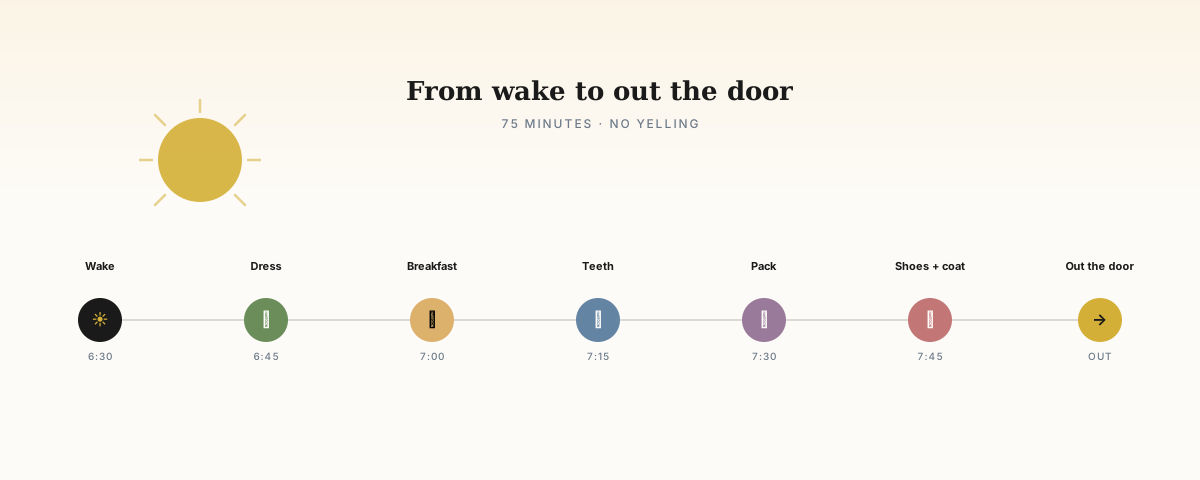
The school-day template (75 minutes)
This is the morning that works for most families with kids ages 6–14, assuming a 7:45 a.m. departure. Shift the times if yours are different — the intervals are what matter, not the exact clock.
| Time | Step | Who's doing what |
|---|---|---|
| 6:30 | Wake | Alarms go off in kids' rooms. No parent wake-ups. |
| 6:45 | Dress | Clothes set out the night before. Kid puts them on, full stop. |
| 7:00 | Breakfast | Sat down at the table. Limited options, decided yesterday. |
| 7:15 | Teeth + face | Bathroom for 5 minutes, no negotiation. |
| 7:30 | Pack | Backpack zipped, lunch in, water bottle filled. |
| 7:40 | Shoes + coat | At the door, full kit. |
| 7:45 | Out | Walking, biking, in the car. |
Notice what's not in there: any decision-making. Every "what" was decided the night before. The morning is execution.
A few notes on each step:
Wake (6:30). The single biggest morning hack: kids wake themselves. A $12 kid alarm clock — analog or digital, depending on the age — does the job. The kid going from "Mom comes in and wakes me" to "my alarm wakes me" is a real developmental shift. Around age 6 is when most kids can do it.
Dress (6:45). Clothes laid out the night before. Underwear, socks, shirt, pants in a stack on the chair. No "go pick something out." That decision was made yesterday by a calmer version of the kid. The kid in the chaos of 6:50 a.m. would pick something that doesn't match and complain about it for the rest of the day.
Breakfast (7:00). Two or three options, max. Cereal + milk, oatmeal, toast + peanut butter, yogurt + fruit. The 90-minute morning is not where you experiment with elaborate breakfasts. Limit the menu, limit the decisions.
Teeth + face (7:15). Five minutes in the bathroom. Get teeth done. Wash face. Get out. This step gets sloppy if it's not its own block — kids will half-do teeth between other steps.
Pack (7:30). This works only if the backpack lives in a specific spot and you packed it last night. Most morning catastrophes happen here because somebody is suddenly remembering at 7:33 that there's a permission slip that needed signing.
Shoes + coat (7:40). Shoes have a spot. Coats have a spot. Doing it as one block prevents the classic "where are my shoes?" 30-second crisis.
Out (7:45). Door opens. Everyone walks through.
The night-before checklist
Half the morning happens the evening before. Here's the 5-minute thing every kid 6+ can do before bed:
- Clothes set out for tomorrow
- Backpack packed (homework in, signed papers in)
- Lunch box on the counter
- Water bottle washed
- Shoes in the shoe spot
- Anything special for tomorrow? (gym day, library day, field trip)
Five minutes at 8 p.m. saves you twenty at 7:30 a.m. The kid does it. Not you. The whole point is that they own it.
This is also where most morning systems quietly fall apart — the night-before step gets skipped on Sunday, then Monday morning is chaos, then Monday night the kid is tired and skips again, and by Wednesday you're back to scrambling. The fix is to make the evening checklist non-negotiable — same way teeth before bed is non-negotiable.
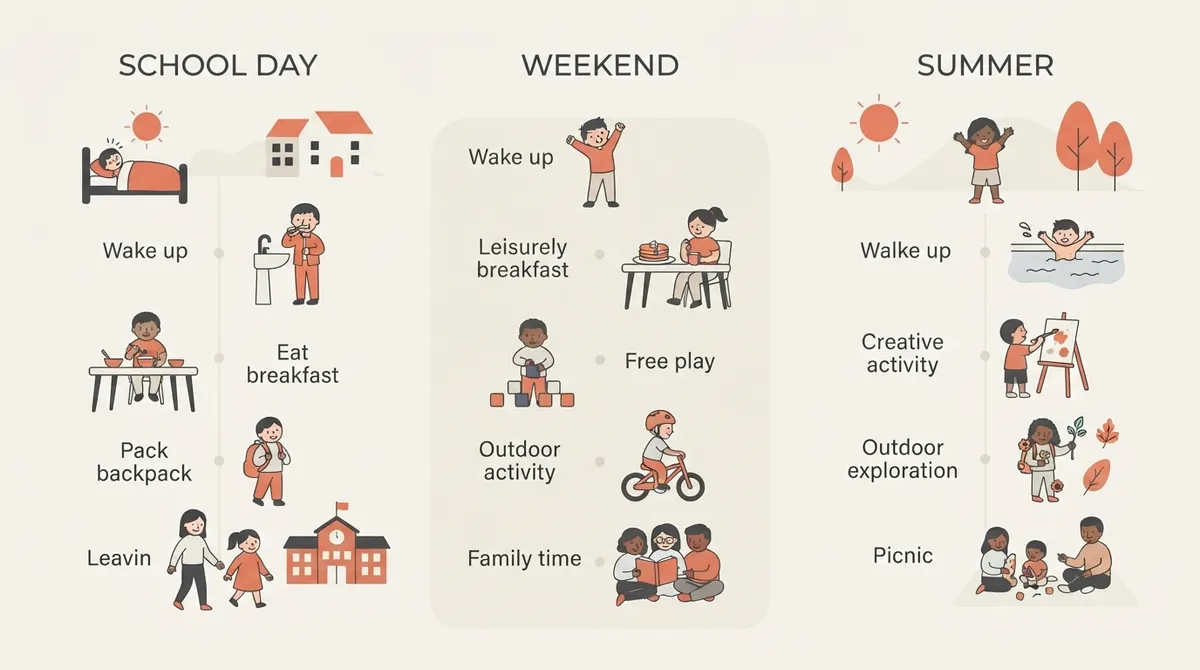
The weekend template
Weekends are different. Two real changes:
No tight time deadline. Wake later, go slower, eat together. The structure of the school morning is in service of getting out the door on time. Without that constraint, the morning can stretch.
The "anchor" stays. Keep one or two anchors from the weekday morning so the kid doesn't fully disengage from the rhythm — teeth + face by, say, 9 a.m. Some kind of breakfast eaten at the table, not in front of a screen. The shape stays, the speed slows.
A typical weekend looks more like:
| Time | What |
|---|---|
| 7:30–8:30 | Kids wake up on their own |
| 8:00–9:00 | Slow breakfast, maybe shared |
| 9:00 | Get dressed, teeth, face — out of pajamas by now |
| 9:00+ | Day starts |
The point of keeping any structure at all is that Monday morning isn't a shock. A kid who was in pajamas until noon Saturday and Sunday is going to find Monday brutal.
The summer template
Summer mornings need a third version. School is out, but if you give kids unlimited freedom they'll be in pajamas at 11 watching TV and you'll wonder how the morning got away.
The summer rule: first hour is structured, the rest is yours.
| Time | What |
|---|---|
| 8:00 | Wake |
| 8:00–8:30 | Get dressed (real clothes, not pajamas), teeth, breakfast |
| 8:30–9:00 | One chore (matched to age) + a short reading block |
| 9:00 | Day is yours |
That first hour does most of the work. By 9 a.m. the kid has eaten, gotten dressed, done one productive thing, and read for a bit. The rest of the day they can earn screen time, see friends, build forts, whatever — but the day didn't start with screens.
For more on the broader summer-week shape, see our summer schedule framework.
The single change that fixes most mornings
If you only do one thing, do this: make the kid own the rhythm.
This means:
- Their own alarm wakes them up. Not you.
- They check the routine (a chart on the wall, a daily list, an app dashboard). Not you reminding them.
- They know what's next without being told.
The shift is from "my parent runs my morning" to "I run my morning, my parent is around if I need help." This is a developmental milestone — and it happens earlier than most parents expect, somewhere between 6 and 8 for most kids.
The change isn't free. There's a transition period (a week or two) where the kid forgets the next step, leaves the backpack open, eats breakfast in two minutes flat. Resist the urge to take over. The cost of the messy transition is small compared to the years of clean mornings you get afterward.
How Haven handles this
Each kid in Haven has their own dashboard. Set up the morning routine once — wake, dress, breakfast, teeth, pack, shoes — and it shows up on their device every morning as a checklist. Kid taps each one as they go.
Two reasons this works better than the paper chart on the fridge:
- It moves with them. They're in their bedroom getting dressed? The list is on their tablet. Bathroom for teeth? Same list, same checkbox. The chart on the fridge only helps in the kitchen.
- It gives them feedback. Every check earns a small visible reward (a streak, points if you've set them up, a satisfying tick). The kid is the one driving the morning, not the parent.
We built the routine-tracking part of Haven specifically for this pattern — partly because all of us had run the fridge-chart version for years and watched it fall off the fridge every time.
Common questions
At what age can a kid handle a morning routine? Most kids can run their own morning at age 7 if the system is set up well. The dress-yourself / wash-yourself parts start working around 5; the timing / sequencing parts catch up around 7. The night-before checklist clicks somewhere around 8.
What if my kid is genuinely slow in the morning? Move the alarm earlier. If the 75-minute morning is too tight, do a 90-minute version. Slow kids aren't the problem; tight schedules are. The cost of waking 15 minutes earlier is real but it's smaller than the cost of yelling for an hour every morning.
My kid has ADHD / executive function struggles. Does this still work? Yes, with adjustments. Visible cues matter more (a checklist they actually look at, not just hear about). Transitions need to be more explicit (timers, "you have five minutes left"). The general structure works; the prompts need to be louder.
How long until this actually works? Two to three weeks. The first week is rough. The second week, a few mornings click. By week three you'll have a couple of mornings that just happen — and then it slowly becomes most of them. Don't grade week one. Grade week four.
What about the kid who wants to negotiate every step? Stop negotiating. The routine is the routine. Once you start adjusting steps in the moment, you're back to running the morning from the front seat. Hold the line for two weeks and the negotiations dry up because they don't work.