
Summer feels great for about three days.
By the second week, the kids are bored. By week four, screen time is creeping up. By week six, someone has cried at the breakfast table about being trapped in the house, and you're googling "is it bad if my kids watch six hours of YouTube." Then there's still a month left.
Ten weeks is long. It's longer than most adult vacations. It's longer than a college semester. And unlike the school year, where structure is provided for you, summer requires you to be the structure — for ten weeks, for every kid, with no break.
This is the schedule framework that actually survives that. It's not "fun activities for summer." It's the higher-level shape of the ten weeks: which weeks have structure, which have rest, which are camp weeks, which are family, and which are intentionally empty.
Don't aim for "fun all summer"
The mistake most families make in June: planning ten weeks of nonstop activities. Camps, swim lessons, road trips, museum days, art classes. Within three weeks the kids are exhausted, the parents are broke, and everyone needs to lie on the couch for a day, but there's a scheduled trampoline park outing in two hours.
Kids don't need ten weeks of fun. They need a mix: structure, family time, novelty, and a meaningful amount of nothing. The "nothing" weeks are the ones where they actually develop the ability to be bored without dissolving — which is a real skill kids lose during the school year and need summer to recover.
A good summer is roughly:
- 2 weeks of structure — usually one at the start, one at the end. The reset week and the school-prep week.
- 3–4 weeks of camp or external activity — gives the kids social time, the parents working time
- 2 weeks of family time — vacation, grandparents, or just intensive family-only weeks
- 2–3 weeks of intentionally unscheduled time — the boredom weeks where they figure out their own days
You can shift the ratios. But every summer needs all four categories. The trap is having too much of one (usually camp) and none of another (usually free time).
Week 1: the reset
The first week of summer should be deliberately boring.
The kids just finished a school year. They're tired. You're tired. Don't kick off summer with a packed schedule — kick it off with a few days of nothing. Let them sleep in. Let them have a slower morning. Let them be slightly bored. This sets the tone that summer isn't going to be "school but with different activities."
A reset week looks like:
- Mornings: free, no agenda, just hang out
- One small daily structure (a 30-min reading block or one chore is enough)
- A few low-key outings (library, park, one friend's house)
- No screens during the day, normal screen rules in the evening
This week buys you cooperation for the rest of the summer. Kids who feel like summer is theirs will sign up for things. Kids who feel like summer is just more school will resist everything.
Weeks 2–3 (and 6, 9 in our example): camp weeks
Camp is the workhorse of a working family's summer. It gives the kids 30+ hours of supervised social time per week, which is what they actually need, and it gives the working parent(s) actual time to work.
A few honest things about camps:
- Day camps are the sweet spot for most kids 6–12. Sleepaway is great for some kids and awful for others; know your kid.
- Don't sign up for back-to-back camps with no break. Even if logistics push you that way, try to put one "reset" day between camps so the kid isn't constantly transitioning.
- Specialty camps (sports, art, theater) work well in middle and high school — the social fit is better when the kids share an interest.
- Camp burnout is real. A kid who is at camp Mon–Fri for six weeks straight will start dragging by week four. Mix camp weeks with non-camp weeks.
If you can swing it, three to four camp weeks across the summer is a solid mix. More than that and you're back to "school but with bug spray."
Weeks 4 and 7–8: family time
Family weeks are when you intentionally step out of "manage the kids while working" mode and step into "we're a family doing things together."
Some families take a long vacation. Some send the kids to grandparents for a stretch. Some just take a week off work and stay home but call it "family week" with intentional activities.
What family time isn't: working from home while the kids watch TV in the next room. That's neither work nor family — it's a third worse thing.
The goal of family weeks is shared memories, not productivity. The kid will not remember every Lego they built in June. They'll remember the camping trip in July, or the week Grandma made pancakes every morning. Concentrated, intentional family time creates the memories that justify the rest of the summer.
Weeks 5 and 9: free weeks (the boredom weeks)
The most important weeks of summer, and the ones most parents try to skip.
A free week is a week with no camp, no big outing, and very few external commitments. The kids are supposed to figure out their own days. Not in a punishment way — in a "you have a backyard, you have books, you have siblings, you have a brain, go" way.
A few rules for free weeks that actually work:
- Loose morning structure — wake up by a reasonable hour, eat breakfast, do one chore. Then the day is theirs.
- Reasonable screen time limits — free week doesn't mean six hours of iPad. The whole point is they have to find non-screen things to do.
- One quiet expectation per day — read for 20 minutes, or write something, or draw something. Light, easy, but they have to do some mental activity.
- You're available, but not the activities director. "I'm bored" gets answered with "great, what are you going to do about it" not with a suggested activity.
The first day of a free week is rough. Kids will complain. By day three, they'll have invented a game with their sibling. By day five, they'll have built a fort, finished a book, and discovered a thing they actually like doing. This is the developmental work of summer — and it only happens if you don't fill every minute.
Week 10: school prep
The last week of summer should be aimed at the first day of school.
Bedtimes start sliding earlier. Mornings start having a small structure. School supplies get bought. A trip to the school happens if it's a new school. Anxious kids get talked through what's coming.
A prep week looks like:
- Bedtime moves 30 minutes earlier every couple of nights
- Wake-up moves earlier to match
- Backpacks get packed (even if there's nothing in them yet) so the routine of "put your backpack by the door" comes back
- One school-related outing — buy supplies, see the school, meet the teacher if possible
- A "last hurrah" thing midweek — pool day, favorite restaurant, something that lets summer end on a high note
By the time school starts Monday, the kids have already been operating on school-shaped days for a few days. The first morning of the year isn't a shock.
What a finished summer looks like
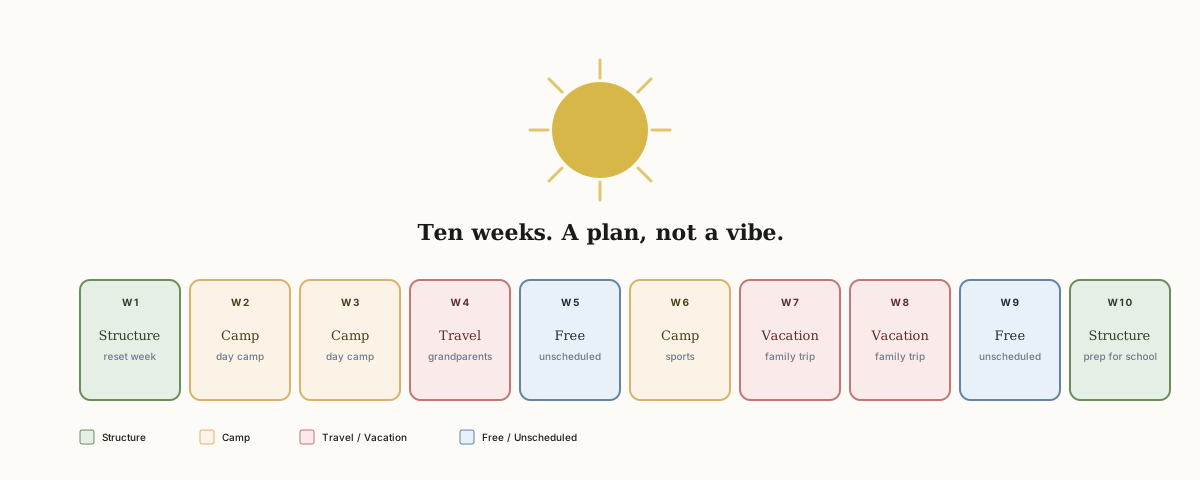
Stitched together, the framework looks something like this — for a family with two working parents and two kids:
| Week | Theme | Notes |
|---|---|---|
| 1 | Structure / reset | Slow week, low expectations |
| 2 | Camp | Day camp #1 |
| 3 | Camp | Day camp #1 (week 2) |
| 4 | Family | Trip to grandparents |
| 5 | Free | Backyard, library, friends |
| 6 | Camp | Different specialty camp |
| 7 | Family | Vacation week 1 |
| 8 | Family | Vacation week 2 (or buffer) |
| 9 | Free | Pre-prep, decompression |
| 10 | School prep | Bedtimes, supplies, mental prep |
That's about three camp weeks, three family-time weeks, two free weeks, and two structure weeks. Adjust the mix for your kids' ages, your budget, and your work schedule — the categories are what matter, not the specific numbers.
The Sunday-night reset
One trick that holds the whole framework together: a brief Sunday-night meeting (10–15 minutes, max) where the family looks at the coming week.
"This is what we're doing Monday. This is who's where. This is what camp pickup looks like. This is what we're having for dinner Wednesday."
It sounds adult-meeting-ish, but for kids 8+ it's actually grounding. They go into Monday knowing what the week looks like. The amount of "wait, what's happening today?" you have to answer drops to nearly zero. It's also where you give the kids their "free week" tasks and reset their chore expectations.
If you want to run this without re-doing the schedule on paper every Sunday, that's roughly what Haven does. Each kid has their own dashboard showing the week ahead. The chores rotate, the events are visible, and Sunday-night meeting becomes a quick glance at the family screen instead of a 30-minute spreadsheet exercise.
Common questions
My kid is too young for camp. What do I do for childcare? Family help, a part-time sitter, a co-op with another family, or partial-week camps (some day camps run only Mon/Wed/Fri). The framework still applies — even toddlers benefit from a mix of structure, family, and unscheduled time. The categories don't change with age, just the activities inside them.
What if we can't afford camp? Many cities run free or low-cost summer programs through parks departments, libraries, or community centers. Look up your local options early — most fill up by April. If those don't work either, lean harder on the family/free categories. Two free weeks can become four. The framework adapts.
Do teens need this kind of structure? Less of it. Teens often have their own ideas about summer (jobs, friends, sleeping until noon). The framework still helps as a shared family understanding — when's the family trip, when are we eating together, when do they need to be home — but the kid increasingly drives their own daily schedule.
Help, it's already July and we have no plan. Take the next ten days and do a free week. Reset. Then plan the rest. Even with a partial summer, the framework works — it just gets compressed. Two camp weeks, one family week, one school-prep week. Same shape, shorter run.