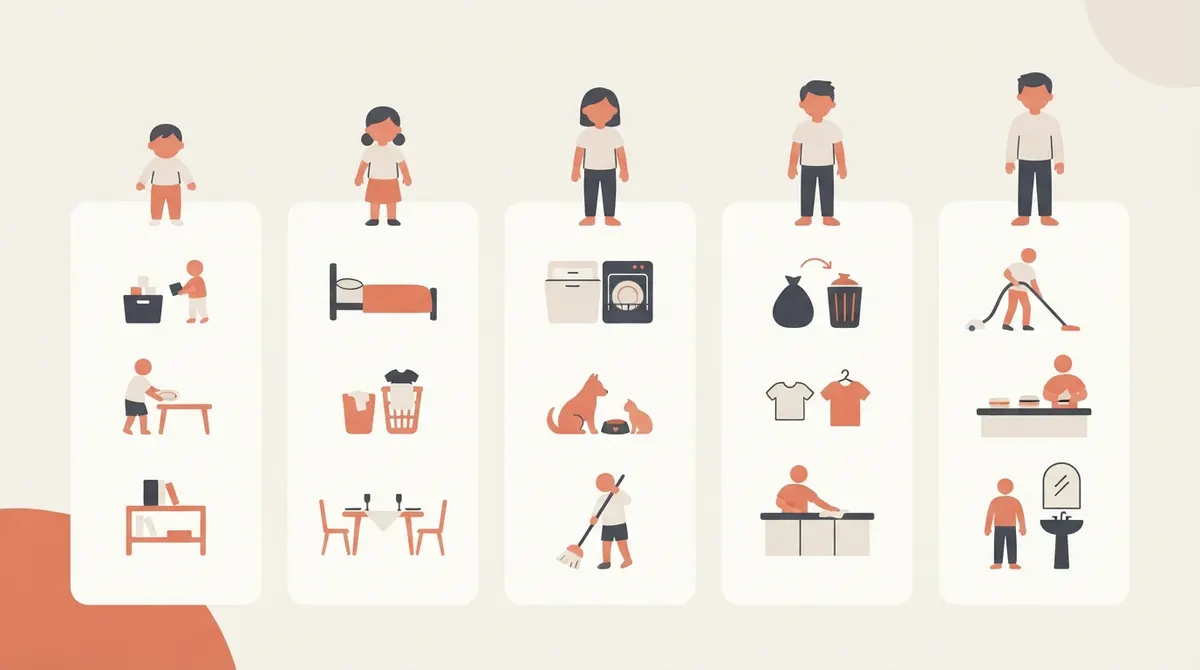
The most common mistake we see with chore charts: parents put the same chore list in front of every kid. Then the four-year-old can't unload the dishwasher, the fourteen-year-old refuses to do something that's clearly beneath them, and within a week the chart is a source of negotiation instead of structure.
Age-appropriate chores aren't about being nice to little kids. They're about matching the task to what the kid can actually finish without you hovering over them. A four-year-old can put toys back in a bin. They cannot make a bed. A nine-year-old can vacuum but probably shouldn't run a load of laundry alone. A fourteen-year-old can roast a chicken, and if you keep handing them the same "wipe the table" chore they had at eight, they'll quietly tune the whole system out.
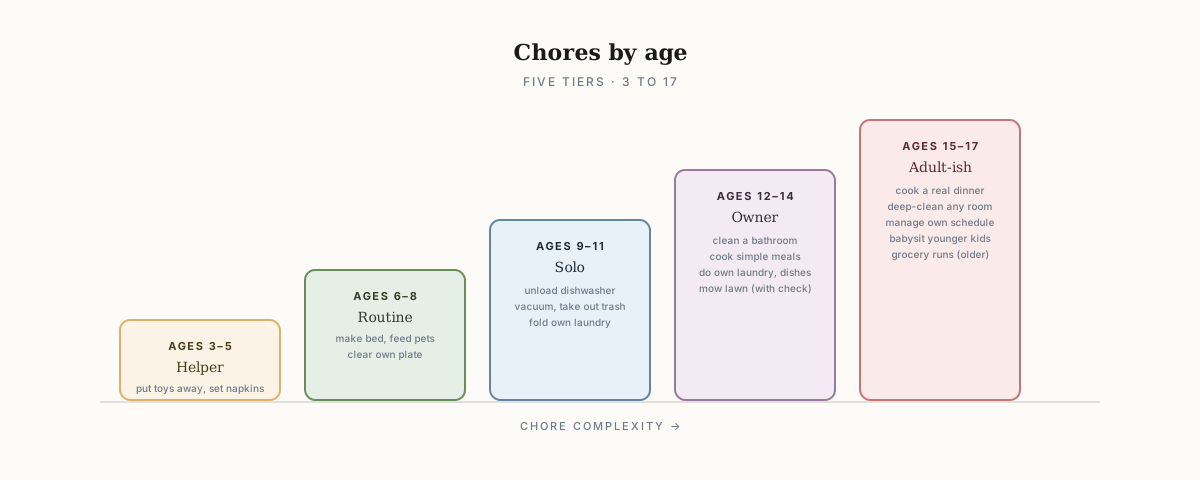
Here are the five tiers we use, with a copy-paste chore list for each.
The rule that decides what belongs where
Before the lists, the one filter that matters: can the kid complete the chore start-to-finish without an adult re-doing any part of it?
Not "can they technically attempt the task." Can they finish it. A three-year-old can "help" with the dishes; they cannot do the dishes. A nine-year-old can technically use a stove, but if you have to stay in the kitchen the whole time, that's still your chore, not theirs.
This filter is unsentimental on purpose. The whole point of a chore system is to take work off your plate, not to add the cognitive load of supervising. If the kid can't own the chore from start to finish — including the parts they don't want to do, like putting the sponge back — it doesn't belong in their tier yet.
Ages 3–5: the Helper tier
What kids this age can actually do: short, single-step tasks where the goal is participation more than output. The chore exists to build the habit of contributing, and to free up two minutes of your time.
Real list:
- Put toys back in their bins (one bin at a time)
- Put dirty clothes in the hamper
- Set napkins or forks at the dinner table
- Wipe up a spill (with your help on the toughest spots)
- Feed a pet (you measure the food, they pour it)
- Put their own shoes by the door
Don't expect quality. Expect compliance. The four-year-old who puts the napkins in a crooked stack has succeeded. Resist the urge to straighten them.
Frequency: daily, very short. If a chore takes longer than 90 seconds at this age, it's the wrong chore.
Ages 6–8: the Routine tier
This is the first tier where chores become real. Kids at this age can complete a task on their own and remember to do it without being prompted most of the time. The chore becomes part of their day.
Real list:
- Make their own bed (loose standards — pulled up, not military-corners)
- Set the full table for dinner
- Clear their own plate after meals
- Feed pets on a schedule
- Wipe down the bathroom counter
- Sort their own laundry into colors and whites
- Water houseplants
- Empty bedroom trash into the kitchen bin
What changes here: the kid owns a recurring responsibility, not just a one-off task. They start to notice when the chore is overdue.
This is the age where a visible chore chart starts to actually work. The system that flopped at age four ("they don't get it") suddenly clicks at age seven. A daily checkbox or sticker is enough; the chart isn't motivating them, it's reminding them.
Ages 9–11: the Solo tier
Big shift. Kids in this tier can handle multi-step chores with adult-grade tools — the dishwasher, the vacuum, the laundry basket — without you in the room. They can also start handling chores that affect other people, which is socially important: the shared kitchen, the shared bathroom, the trash that the whole family generates.
Real list:
- Unload the dishwasher entirely (you load, they unload — or vice versa)
- Vacuum the main living areas
- Take out the trash and recycling
- Sweep or Swiffer hard floors
- Fold their own laundry (and put it away)
- Pack their own school lunch (you set the rules; they execute)
- Make a simple breakfast on the weekend (cereal, toast, fruit)
- Walk the dog (in safe neighborhoods)
- Clean their own room weekly with adult-acceptable standards
The catch at this age: kids in this tier will negotiate. They've figured out that chores are work and that work is unevenly distributed in the household. This is when point systems and allowance conversations get real (more on that next week), and when fairness arguments start to require actual fairness — not just the appearance of it.
Ages 12–14: the Owner tier
Tweens own areas, not just tasks. Instead of "wipe the bathroom counter," it's "the upstairs bathroom is your responsibility — keep it clean." They can use the stove without supervision, mow the lawn after one or two coached sessions, and handle their own laundry from start to finish.
Real list:
- Clean a full bathroom (toilet, tub, sink, floor)
- Cook simple meals — pasta, rice, scrambled eggs, sandwiches, grilled cheese
- Do their own laundry start to finish
- Load and unload the dishwasher
- Mow the lawn (after one supervised session)
- Watch younger siblings for short stretches (30–60 min)
- Take responsibility for one weekly shared chore (vacuuming, trash, dishes)
- Bring in groceries from the car and put them away
What changes here: chores become contributions to the household, not just personal tasks. Twelve-year-olds notice that the family is a unit and that contributions are visible. A kid who has been cooking dinner once a week since age 13 will be a 17-year-old who can feed themselves at college — that's the whole goal.
This is also the tier where rotation systems start to matter. With multiple kids in the 12+ range, you can rotate the big jobs fairly so nobody ends up permanently stuck with the worst chore.
Ages 15–17: the Adult-ish tier
The goal of the chore system from age three onward is to land here: a teenager who can run a household if they had to. Not because you're going to make them, but because in two to four years they'll need to.
Real list:
- Cook a real dinner from a recipe (twice a week is a great target)
- Deep-clean any room in the house
- Manage their own schedule, appointments, and deadlines
- Babysit younger siblings for longer stretches
- Do grocery runs (with a list — older teens with a license)
- Handle their own paperwork (school forms, permission slips, etc.)
- Take ownership of a weekly household role (e.g., owns dinner Wednesdays, owns laundry Sundays)
- Drive younger siblings to activities (with a license)
What changes here: chores stop being chores. They're "things I do because I'm part of this family." A 17-year-old who cooks Wednesday dinner doesn't think of it as a chore; they think of it as their thing. That's the win.
The printable shortcut
Here's the whole thing in one table, ready to copy into a chore chart, a doc, or a chore-tracking app like Haven:
| Tier | Age | Anchor | Examples |
|---|---|---|---|
| Helper | 3–5 | Participate | Put toys away, set napkins, hamper laundry |
| Routine | 6–8 | Daily ownership | Make bed, set table, feed pets, sort laundry |
| Solo | 9–11 | Multi-step alone | Unload dishwasher, vacuum, trash, fold laundry, pack lunch |
| Owner | 12–14 | Own an area | Clean a bathroom, cook simple meals, own laundry, mow lawn |
| Adult-ish | 15–17 | Run pieces of the household | Cook real dinner, deep clean, schedule self, babysit |
What to do when you have kids in different tiers
This is the actual hard problem. A typical family has a five-year-old, a nine-year-old, and a thirteen-year-old all looking at the same chore chart, and the math has to feel fair to all three.
Two things that work:
1. Tier-separated chore lists. Each kid sees only their tier's chores. The five-year-old doesn't see the thirteen-year-old's list and feel either jealous or relieved. The thirteen-year-old doesn't look at the five-year-old's two chores and feel resentful that they got six. Each kid sees their own list as a complete world.
2. Equal time, unequal complexity. A 5-year-old doing two minutes of helper chores and a 13-year-old doing fifteen minutes of owner chores can both feel fair if the time is proportional to age. The complexity gap doesn't matter as much as the time gap, and time is something kids can see and measure.
The mistake to avoid: trying to make the same chore work across tiers. "Set the table" for a 5-year-old means napkins. For a 13-year-old it means the full table including drinks. If the chore list just says "set the table," you'll get napkins from the 13-year-old too.
How Haven handles this
We built this directly into Haven. Each family member has a type (Adult / Child) and you can assign chores to specific kids, so a 5-year-old's dashboard shows their two helper-tier chores and a 13-year-old's shows their owner-tier list. Same family, same household, same point system underneath — different surfaces for each kid.
If you've been hand-managing a chore chart that tries to be everything to every kid at every age, Haven does the partitioning for you. Worth a look — free to start, and the rotation logic handles the multi-kid fairness math automatically.
Common questions
At what age should a kid have any chores at all? Three. The chores at that age are tiny — putting one toy back, handing you a fork — but the habit of contributing is what you're building, not the work itself.
Should chores be tied to allowance? Not exactly. This is its own conversation and we'll cover it in next week's post in detail, but the short version: tying every chore to money makes refusing easier ("I'll just skip the dollar this week"). Tying some extra chores to money works better.
My kid is 10 but can do almost everything in the 12–14 tier. Should I move them up? Yes. The ages are bands, not ceilings. If a 10-year-old is ready for the Owner tier in terms of skill and responsibility, give them owner-tier chores. The ages exist to set expectations for what's typical — they're not requirements.
What about ADHD or executive-function struggles? Match the tier to the kid's executive function, not their age. A 12-year-old who consistently forgets the trash on Tuesdays might do better on a Routine-tier (6–8 typical) chore set with visible reminders, then graduate up as the habit sticks. There's no shame in matching the system to the kid you actually have.